
Coagulants, Flocculants, and the Right Separation Train.
Chemistry calibrated to your TSS load, oil content, particle charge, and target effluent quality. Clarifiers, DAF, batch systems, cross-flow filtration — different separation technologies need different chemistry approaches.
Four System Types, Four Chemistry Approaches
Equipment dictates chemistry. The same wastewater stream needs different coagulant-flocculant combinations depending on whether it ends in a clarifier, a DAF, or a membrane.
Conventional Clarifiers
Gravity settling for dense inorganic solids and high-volume continuous flow. Coagulant choice driven by particle charge and pH — alum, ferric chloride, PAC, organic polymers. Flocculant for floc strength and settling velocity. Sludge handling chemistry as a follow-on consideration.
Dissolved Air Flotation (DAF)
Flotation separation for oily wastewater, low-density biological solids, and light organic matter. Polymer selection matched to bubble attachment kinetics — typically cationic polymer at the inlet with anionic finishing polymer pre-flotation cell. Recycle rate and pressure tuning affect chemistry dosage.
Batch Treatment
Intermittent flows or smaller operations. Batch chemistry calls for adjusted dosages: short reaction time, mixed solids settling, clean decant. Operator-dependent — written batch procedures and operator training are part of the program design.
Cross-Flow Membrane Filtration
Membrane separation needs chemistry compatible with membrane materials. Coagulant choice has to avoid fouling; flocculant dosing matched to crossflow velocity. Membrane longevity is part of the program design, not an afterthought.
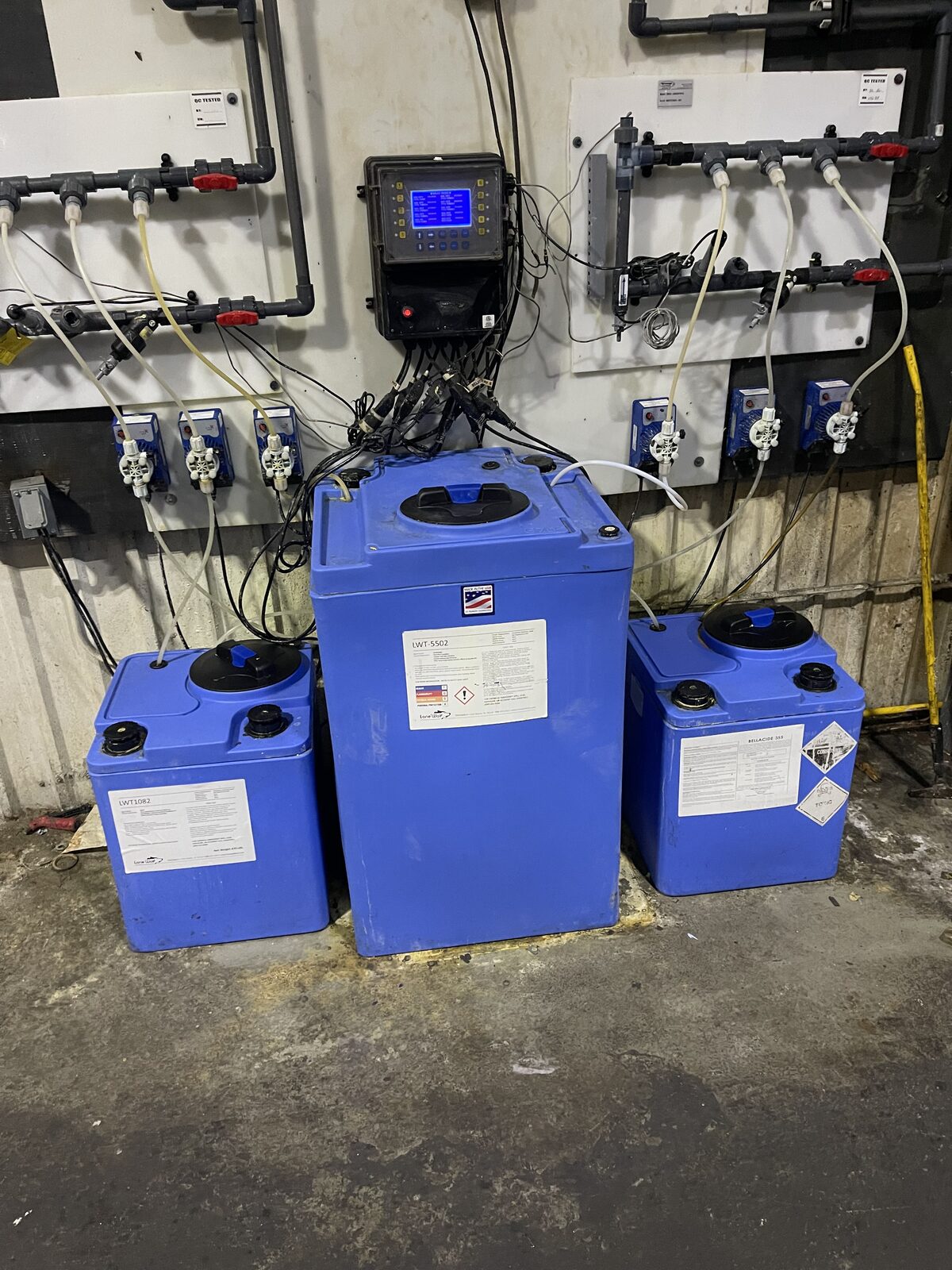
Coagulant First. Flocculant Second. Both Matter.
Coagulants neutralize surface charge that keeps fine particles suspended. Inorganic coagulants (alum, ferric chloride, polyaluminum chloride) are workhorses for high-volume continuous flows. Organic polymers can sometimes replace inorganic chemistry where sludge volume matters.
Flocculants — high-molecular-weight polyacrylamides in anionic, cationic, or non-ionic charge — bridge the destabilized particles into larger flocs that settle, float, or filter out. Charge density, molecular weight, and polymer activation all matter. Lone Wolf programs include bench-test screening to confirm the right polymer for your matrix before committing to production dosing.
- Inorganic + organic coagulants
- Anionic/cationic/non-ionic polymers
- Polymer activation engineering
- Bench-test screening included
- Sludge volume optimization
- Dewatering chemistry follow-on
Separation FAQ
What's the difference between a coagulant and a flocculant?
Coagulants (alum, ferric chloride, polyaluminum chloride, organic polymers) neutralize the surface charge that keeps fine particles suspended. Flocculants (high-MW polyacrylamides, anionic, cationic, or non-ionic) bridge the destabilized particles into larger flocs that settle, float, or filter out. Most wastewater programs use both — coagulant first, then flocculant.
When do you choose DAF over a clarifier?
Dissolved air flotation works well when the solids float more readily than they settle — oily wastewater, low-density biological solids, light organic matter. Clarifiers work better for dense inorganic solids and high-volume continuous flows. Sometimes both are appropriate in series.
What about batch treatment systems?
Batch systems are common in smaller operations or where flows are intermittent. We design batch chemistry programs with adjusted dosages for short reaction times, mixed solids settling, and clean decant. Operator training is part of the program — batch systems are operator-dependent in ways continuous systems aren't.
Can you design for cross-flow membrane filtration?
Yes. Chemistry choices change when the downstream separation is a membrane: coagulants and flocculants have to be compatible with membrane materials, and chemistry residuals can foul or scale membranes. Programs are sized to protect the membrane life as well as deliver effluent quality.