
Precipitation and Stabilization for the Hard Matrices.
Plating rinses. Paint booth water. Machining coolant. Refinery process water. Industrial wastewater carries metals in matrices where standard hydroxide precipitation under-performs. Proprietary chemistry — including our LWT-9450 stabilizer — for the cases where off-the-shelf can't get below discharge limits.
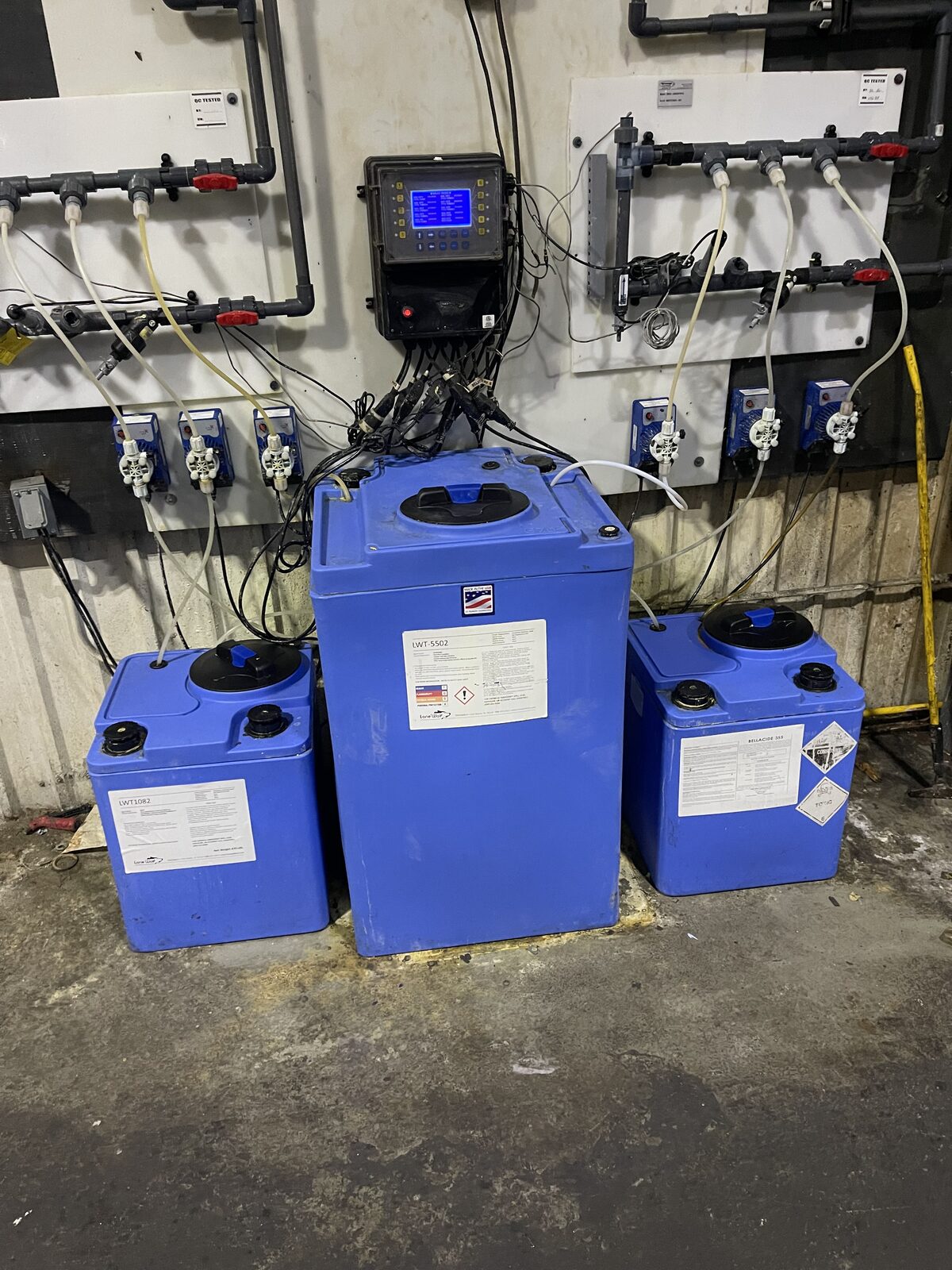
Precipitation, Then Stabilization.
Standard hydroxide precipitation works when metals are simply dissolved at near-neutral pH. Industrial reality is rarely that clean. Metals come with chelating agents, complex with cyanide or amines, or sit in low-pH plating baths that re-dissolve when raised to precipitation pH.
Lone Wolf programs combine the right pre-treatment (chelate breaking, reduction for Cr6+, oxidation for sulfide-bearing streams) with the right precipitant for the matrix. The stabilization step — often LWT-9450 — produces solids that pass TCLP for non-hazardous landfill in most applications and resist re-dissolution downstream.
- Hydroxide precipitation (standard)
- Sulfide precipitation (low-residual)
- LWT-9450 stabilization
- Chelate breaking (EDTA, NTA, citrate)
- Cr6+ → Cr3+ reduction step
- Cyanide oxidation (alkaline chlorination)
When Standard Precipitation Falls Short
Some matrices defeat off-the-shelf chemistry. We formulated for those cases.
LWT-9450 Metal Stabilizer
LWT-9450 was developed for industrial matrices where standard hydroxide or sulfide precipitation either won't reach the discharge limit or produces solids that fail TCLP. Common applications: mixed-metal plating rinses with chelating agents, paint booth water with phosphate complexants, refinery process water with hydrocarbon co-contaminants, and machining coolants with surfactant emulsions.
The stabilizer produces flocculant solids that filter cleanly on belt presses, plate-and-frame, or rotary drum filters. Solids typically pass TCLP for non-hazardous landfill — a meaningful operating-cost reduction over hazardous waste manifests. Programs include written batch procedures, dosing targets, and operator training where needed.
Metal Removal FAQ
Which metals can Lone Wolf treat?
Lead, copper, zinc, nickel, cadmium, trivalent and hexavalent chromium (with reduction step for Cr6+), iron, aluminum, and combinations. Programs are designed around your specific discharge limits and the matrix the metals are coming from — plating rinse, paint booth, machining coolant, or other industrial streams.
What is LWT-9450?
LWT-9450 is a proprietary metal precipitant and stabilizer formulated for industrial matrices where standard hydroxide or sulfide precipitation under-performs — chelated metals, complexed wastestreams, and mixed-metal discharges. It produces stable, filterable solids that meet TCLP for non-hazardous landfill in most applications.
Can you handle hexavalent chromium?
Yes — with a reduction step. Hexavalent chromium (Cr6+) must be reduced to trivalent chromium (Cr3+) before precipitation. Reduction chemistry typically uses sulfite, metabisulfite, or ferrous sulfate at acidic pH, followed by pH adjustment and precipitation.
What about chelated metals?
Chelated metals (from EDTA, NTA, citrate, gluconate, or amine-based cleaners) don't precipitate with simple hydroxide chemistry. We use chelate-breaking pretreatment — oxidation, sulfide precipitation, or proprietary LWT chemistries — to release the metal from the chelating agent before standard precipitation.
Do treatment residuals pass TCLP?
In most applications, yes. LWT-9450-stabilized solids pass TCLP for the metals targeted in the discharge stream. We can run pre-application bench tests on your specific matrix to confirm before committing to a full program.