
Cooling Tower Chemistry, Sized to Your System.
Open recirculating systems, evaporative condensers, induced-draft towers. Programs designed around your LSI, your cycles of concentration, your biocide rotation cadence, and the ASHRAE 188 Legionella requirements your facility is operating under.
Industrial cooling tower water treatment prevents scale, corrosion, and biological growth in recirculating cooling water systems. The program combines corrosion inhibitors sized to your Langelier Saturation Index, oxidizing and non-oxidizing biocide rotation, real-time ATP biological monitoring, and conductivity-controlled blowdown — designed to your specific water chemistry and system load, not a generic template.
Cooling Tower Programs Stand on Four Things
Skip any one of these and the program runs on borrowed time. We don't ship a program that lacks any of them — every cooling tower account gets all four.
Lone Wolf's integrated treatment approach emphasizes engineering programs to reduce chemical use — pairing the right inhibitor package with operational controls (cycles management, blowdown optimization, side-stream filtration) so your facility doesn't pay for chemistry the system doesn't need. Lower chemical consumption, better operating cost, fewer compliance touchpoints.
Scale & Corrosion Inhibitors Sized to Your LSI
Langelier Saturation Index drives scale potential. Inhibitor blend (phosphonates, polymers, azoles for yellow metals, molybdate or zinc where chemistry allows) is sized to hold the recirculating water at a slightly positive but controlled LSI. Dosage targets are documented in the program proposal, not improvised.
Oxidizing + Non-Oxidizing Biocide Rotation
Oxidizing biocides (chlorine, bromine, chlorine dioxide, stabilized halogens) work fast across broad microbial populations. Non-oxidizing biocides (isothiazolinones, glutaraldehyde, DBNPA, quats where appropriate) penetrate biofilm and target organisms developing resistance. Selection criteria include the bacteria types present in your water, your discharge regulations, your equipment specifics, and your operating conditions. Rotation cadence is set per system — typically alternating weeks or every other batch.
ATP Monitoring + Biological Control
ATP (adenosine triphosphate) testing during service visits gives a real-time biological activity reading independent of slow culture work. Action limits set at program design, trended over time, and tied to biocide adjustments. Plate counts where the application requires more traditional reporting.
Blowdown Management at Cycles Target
Cycles of concentration is the lever between scale and chemistry cost. Conductivity-based blowdown control holds cycles at the target the inhibitor program is designed for. Tied to makeup chemistry, target LSI, and the biocide dosage that's working with — not against — the dissolved solids.
Sample Program Detail — Industrial Comfort Cooling Tower
- Tonnage
- 500 to 1,500 tons, ~3-5 cycles target
- Inhibitor Blend
- Phosphonate-azole-polymer multifunctional, dosed by conductivity-tied chemical pump
- Oxidizer
- Stabilized bromine via brominator with chlorine boost on capacity demands
- Non-Oxidizer
- Isothiazolinone alternating with DBNPA or glutaraldehyde per rotation
- ATP Action Limit
- < 100,000 RLU = green · 100k-300k = action · > 300k = corrective + sample pull
- Service Cadence
- Weekly site visit with full chemistry panel + ATP + system observations
A 1/64-inch biofilm on heat transfer surfaces can drive energy costs up by 30%. ATP monitoring with strict action limits keeps biofilm under control — protecting heat transfer efficiency, water/sewer cost, and asset life.
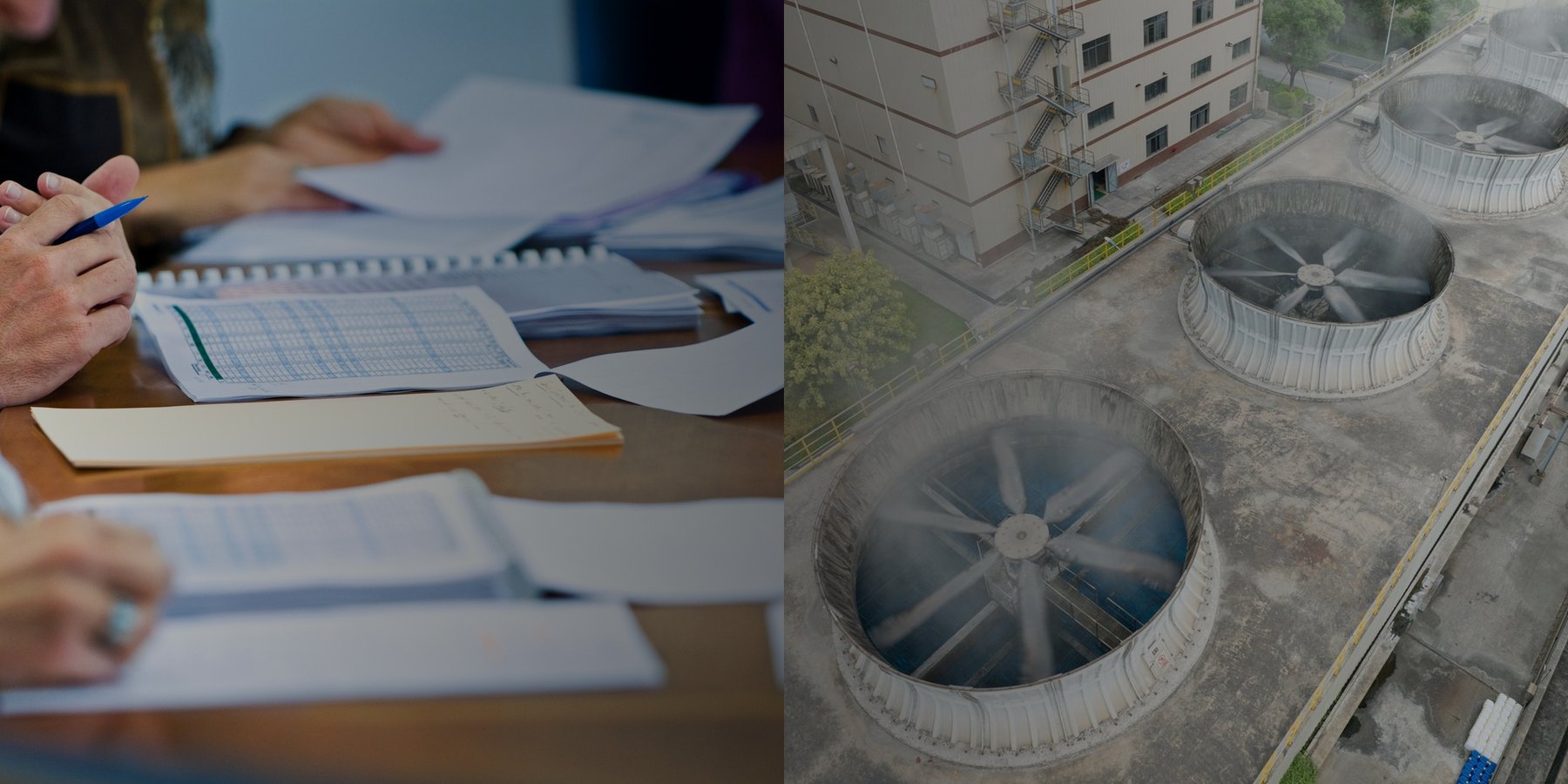
Written Water Management Program — Documented and Auditable.
ASHRAE 188-2018 requires a written water management program for any facility with cooling towers, decorative fountains, hot water systems above certain thresholds, or other Legionella-risk equipment. Hospitals, healthcare facilities, hotels above 10 stories, large commercial buildings — the regulation is broader than most operators realize.
Lone Wolf cooling tower programs include the written WMP, control measures, monitoring schedule, validation activities, corrective action protocols, and documentation packet — built into the program from day one rather than bolted on after an audit notice arrives.
- Written Water Management Program
- Control measure documentation
- Monitoring schedule + thresholds
- Validation activities + records
- Corrective action protocols
- Audit-ready documentation packet
Cooling Tower FAQ
What is LSI and why does it matter?
Langelier Saturation Index measures calcium carbonate scaling tendency in cooling tower water. A positive LSI means the water tends to scale; negative LSI means it tends to corrode. Programs are designed to hold the recirculating water at a slightly positive but controlled LSI, with inhibitors sized to prevent scale formation at that operating point.
Why rotate oxidizing and non-oxidizing biocides?
Microorganisms develop resistance to a single biocide chemistry over time. Rotating oxidizing biocides (chlorine, bromine, chlorine dioxide) with non-oxidizing biocides (isothiazolinones, glutaraldehyde, DBNPA) prevents adaptation. Oxidizers work fast across broad populations; non-oxidizers penetrate biofilm and target resistant organisms.
What does ATP monitoring tell you?
ATP (adenosine triphosphate) is present in all living cells. Measuring ATP in cooling tower water gives a real-time biological activity reading — independent of slow culture-based testing. RLU (relative light unit) trends show whether the biocide program is keeping biological load in check.
What does ASHRAE 188 require?
ASHRAE 188-2018 requires a written water management program for cooling tower and other water systems at risk of Legionella growth. The program must include control measures, monitoring schedule, validation steps, corrective action procedures, and documentation. Required for hospitals, healthcare, hotels above 10 stories, and many commercial facilities.
Do you treat closed-loop and chilled-water systems too?
Yes. Closed-loop chemistry differs from open recirculating cooling towers — near-zero makeup, different corrosion inhibitor selection, different biological control approach. See the Water Treatment hub for closed-loop program detail.